








All family matter
ByExplorer
The Last Train from Marina Bay
Share your love
Singapore always looked brightest to people who had somewhere to be. To Mei, it looked brightest when she was trying not to go home.
By seven-thirty, the office at Raffles Place had emptied, but she was still staring at her laptop, pretending to revise a report she had already submitted. Her manager had called her “reliable” again that afternoon, which was really just another way of saying, “You’ll stay late and won’t complain.” When she finally shut the screen and left, the city outside was glowing with the confidence she no longer felt.
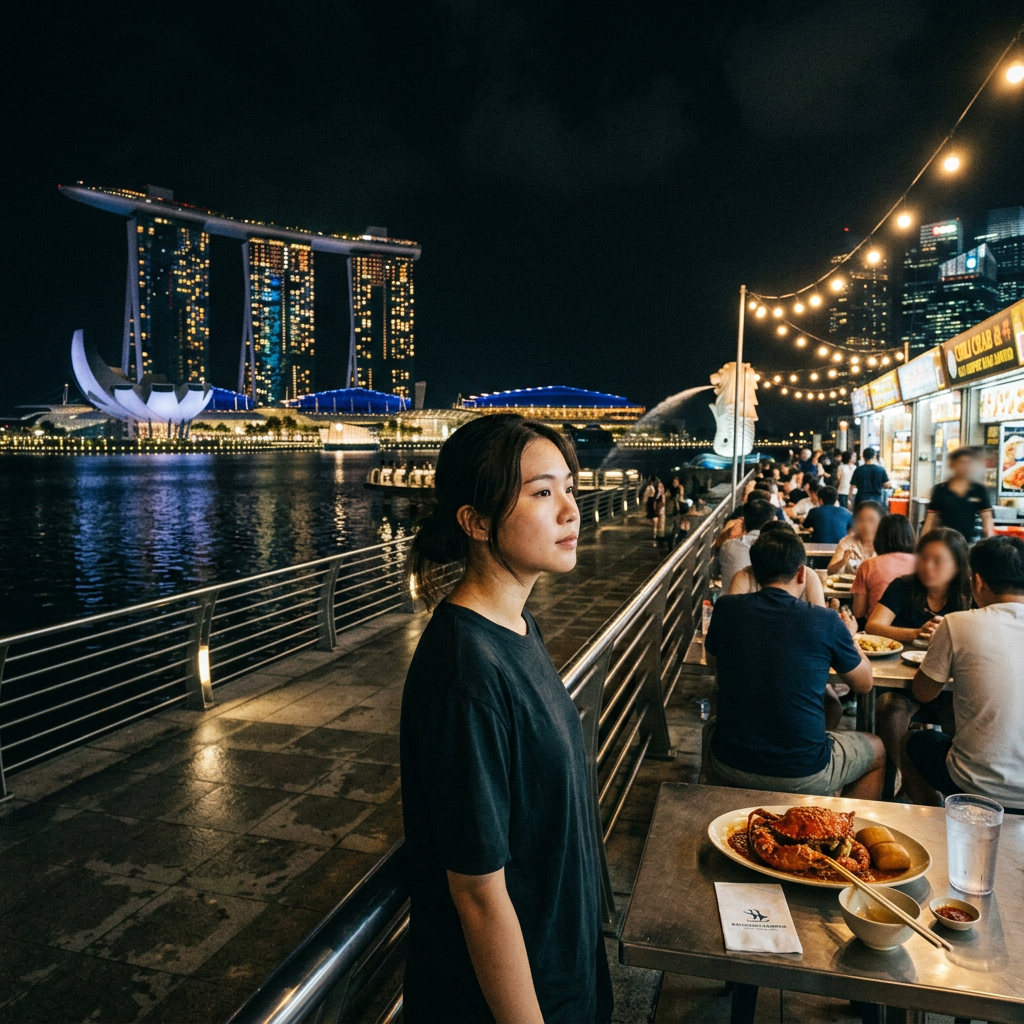
She drifted into a nearby Hawker Centre, following the noise of clattering plates and the smell of frying garlic. At one stall, a cook in a red apron was lifting a wok full of thick, fragrant sauce over a plate of Chili Crab. The scent hit her so suddenly that she stopped in her tracks.
Her father used to bring her for chili crab on the days she cried after exams. “Bad result only, not end of the world,” he would say, cracking the shell neatly while she laughed at the mess on her fingers. He had been gone three years now, but sometimes grief returned in ordinary places, hidden inside a smell.
Her phone buzzed.
Mum: Your brother says he doesn’t want poly anymore. Can you talk to him tonight?
A second message appeared before Mei could answer.
Mum: He listens to you. Don’t make things worse.
Mei stared at the screen until the words blurred. She was tired of being the sensible one, the daughter who fixed forms, paid bills, explained feelings, and absorbed everyone else’s panic. She slipped the phone into her bag without replying and kept walking.
Soon she found herself by the water, the skyline opening around her in glass and light. Marina Bay Sands rose ahead like a ship balanced on the city’s shoulders, impossible and expensive. Tourists leaned over railings for photos. A group of teenagers laughed near the Merlion, trying to angle their poses so the white statue looked as if it were pouring water into their mouths.
Mei watched them and almost smiled. Singapore could be a bit ridiculous sometimes, but it was hers. The polished towers, the tired MRT rides, the aunties reserving seats with tissue packets, the small bursts of Singlish floating through the night like music only locals fully understood.
“Wah, serious ah? You still make that stress face.”
She turned. It was Nadia, her secondary school friend, standing there with a shopping bag and the same sharp eyes she had at sixteen.
“Nadia?” Mei blinked. “So long never see.”
“Ya lor,” Nadia said. “I saw you from there. You look like you want to fight the whole CBD.”
Mei laughed despite herself. “Maybe I do.”
They walked together toward the MRT, talking in fits and starts. Nadia now worked irregular shifts as a nurse and looked exhausted in a way Mei recognized instantly.
“Honestly,” Nadia said, “I nearly quit last month. Then my mother told me I must be grateful, cannot be weak. As if saying tired means no gratitude like that.”
Mei swallowed. “My family also like that. Everything somehow becomes my problem to solve.”
Nadia stopped near the station entrance. Beyond them, trains hummed under the city, carrying strangers toward home. “Then maybe don’t solve everything,” she said. “You always do this, Mei. You act steady until one day you collapse.”
“I can’t just not care.”
“I never say don’t care. I say don’t disappear inside caring.”
The words landed harder than Mei expected. She thought of her brother waiting, angry and confused. She thought of her mother, who spoke in commands whenever she was frightened. She thought of herself at twelve, licking chili sauce from her fingers while her father reminded her that not every setback was a disaster.
For the first time that evening, Mei took out her phone and called home.
Her brother answered. “What?”
“Don’t what me,” she said automatically, then softened. “Tell me what happened. Properly.”
There was a long silence. Then his voice cracked. He admitted he was failing, admitted he hated his course, admitted he was terrified of disappointing everyone.
Mei leaned against the railing outside the station, eyes stinging. “Aiyo,” she murmured, half laughing, half crying. “Why never say earlier?”
By the time she boarded the train, they had made a plan. Not a perfect one, but enough: talk as a family, meet his lecturer, stop pretending fear was laziness.
She got off at Orchard Road first, not to shop, but to breathe. The bright storefronts reflected endless versions of herself back at her: worker, daughter, sister, fixer. Yet somewhere among them was simply Mei, tired but still trying.
Later that night, she met her mother and brother at the neighbourhood coffee shop below their block. The seafood stall was closing, but there was just enough time to order one small plate of chili crab to share. Her mother protested at the price, her brother rolled his eyes, and Mei laughed for real this time.
They ate with their hands, messy and silent at first. Then the conversation came, awkward but honest. No miracles, no dramatic speeches. Just three people finally speaking as if they were on the same side.
When Mei looked up, the city around them was still awake: buses groaning past, uncles arguing over football, cutlery ringing against bowls. Singapore remained busy, crowded, and demanding. But under the fluorescent lights of that ordinary table, with sauce on her fingers and family beside her, Mei no longer felt lost in it.
She felt, at last, like she was on her way home.