






All family matter
ByExplorer
The Effects of Climate Change on Coral Reefs
Share your love
Coral reefs are among the most biologically diverse and biogeochemically significant ecosystems on Earth, yet they are also among the most climate-sensitive. Built over long timescales by scleractinian corals and other calcifying organisms, reefs support complex food webs, protect shorelines from wave energy, sustain fisheries, and contribute substantially to tourism economies. For researchers, students, and scientifically minded readers, coral reefs also function as sentinel systems: their condition provides an early and highly visible indicator of how anthropogenic climate forcing is altering marine ecosystems.
The relationship between climate change and coral reefs is now supported by a large and convergent body of scientific evidence. Rising sea-surface temperatures, marine heatwaves, ocean acidification, deoxygenation, sea-level rise, and intensifying storm regimes interact with local stressors such as pollution and overfishing to reduce coral growth, increase bleaching frequency, alter species composition, and diminish ecosystem resilience. Although some corals and reef regions exhibit partial thermal tolerance or acclimatization capacity, the broader literature indicates that continued warming will cause widespread degradation of reef structure and function. This article provides a detailed scientific overview of climate change coral reefs research, including the underlying principles of reef biology, major current findings, key uncertainties, counterarguments, and future directions.
Coral Reefs in Context: Ecological and Biogeochemical Foundations
Coral reefs are biogenic carbonate structures produced primarily by reef-building corals, especially shallow-water tropical scleractinians that precipitate aragonite skeletons. These corals exist in symbiosis with photosynthetic dinoflagellates in the family Symbiodiniaceae, which provide a large proportion of the host’s energetic requirements through photosynthate transfer. In return, the coral host offers shelter, metabolic waste products, and access to light in oligotrophic tropical waters. This mutualism underpins coral productivity, calcification, and the construction of three-dimensional reef frameworks.
The ecological success of coral reefs depends on relatively narrow environmental conditions. Most reef-building corals thrive within constrained thermal ranges, stable carbonate chemistry, sufficient light availability, and low sediment loading. Small shifts in temperature or seawater chemistry can disrupt metabolic balance, impair calcification, and destabilize host-symbiont interactions. This sensitivity helps explain why climate change coral reefs research has become central to marine science: coral reefs respond rapidly and often dramatically to environmental anomalies that may initially appear modest in global average terms.
Coral Anatomy, Symbiosis, and Reef Construction
A coral colony is composed of many genetically identical polyps embedded in living tissue overlying a calcium carbonate skeleton. Calcification occurs in a semi-isolated extracellular space where ion transport and carbonate chemistry regulate aragonite deposition. This process is physiologically costly and strongly influenced by temperature, pH, and nutrient availability. While some reef accretion also derives from coralline algae and other calcifiers, corals are the principal framework builders in most tropical reefs.
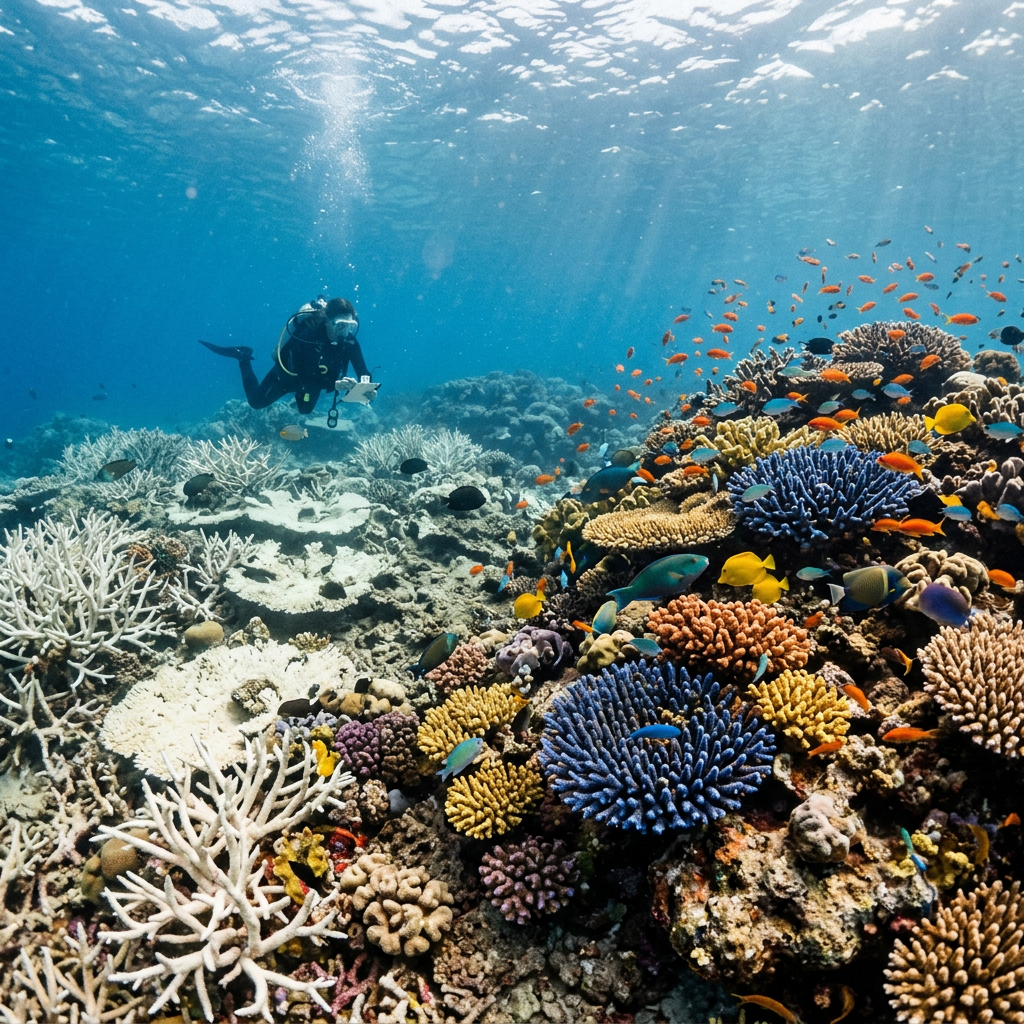
Symbiosis is central to reef persistence. Under favorable conditions, endosymbiotic algae enhance energy acquisition and promote rapid calcification. Under stress, however, this partnership becomes fragile. Elevated temperature can damage the photosynthetic apparatus of symbionts, increase the production of reactive oxygen species, and trigger breakdown of the symbiosis. When symbionts are expelled or their pigments are lost, corals appear white, producing the phenomenon known as bleaching.
Why Coral Reefs Are Climate-Sensitive Systems
Coral reefs are especially vulnerable because their biological productivity and structural growth are threshold-dependent. Reef systems often persist near upper thermal limits, meaning that even relatively small anomalies above historical summer maxima can induce bleaching. Similarly, carbonate chemistry changes associated with increased atmospheric carbon dioxide reduce aragonite saturation state, making skeleton formation more energetically expensive. In this sense, reef ecosystems operate close to critical physiological and geochemical boundaries.
Their sensitivity is amplified by disturbance interactions. Coral populations recovering from one bleaching event may be less able to withstand subsequent heat stress, disease outbreaks, cyclones, or nutrient pulses. Recovery requires time, larval supply, herbivory, and suitable settlement habitat. If disturbances become too frequent, reefs can shift from coral-dominated states to assemblages characterized by rubble, turf algae, or macroalgae. These transitions reduce habitat complexity and ecosystem services even when some coral cover remains.
Climate Change Stressors Affecting Coral Reefs
The effects of climate change on coral reefs cannot be attributed to a single driver. Rather, they emerge from multiple interacting physical and chemical stressors whose impacts may be additive, synergistic, or context dependent. Ocean warming remains the dominant cause of mass bleaching, but acidification, deoxygenation, changing storm regimes, and sea-level rise all contribute to reduced reef performance and resilience.
Understanding climate change coral reefs dynamics therefore requires a process-based approach. At the physiological level, stress alters metabolism, calcification, immunity, and reproduction. At the population and community levels, it changes mortality rates, competitive interactions, recruitment success, and species composition. At the ecosystem level, it influences carbonate budgets, structural complexity, and the capacity of reefs to provide fisheries habitat and coastal protection.
Ocean Warming and Marine Heatwaves
Anthropogenic greenhouse gas emissions have increased ocean heat content, and coral reefs are now exposed to more frequent and more intense thermal anomalies than in the historical past. Short-term marine heatwaves are especially important because corals can tolerate a limited amount of warming for brief periods, but accumulated thermal stress above local thresholds causes bleaching. The metric Degree Heating Weeks, used widely in reef forecasting, integrates intensity and duration of heat exposure and has proven valuable for predicting bleaching risk.
Mass bleaching events documented in 1998, 2010, and 2014–2017 illustrate the scale of the problem. Hughes et al. (2017) showed that repeated marine heatwaves on the Great Barrier Reef caused severe bleaching and changed the composition of coral assemblages over vast spatial scales. Importantly, bleaching is not merely a cosmetic indicator of stress. It can suppress growth, reduce fecundity, increase disease susceptibility, and cause partial or complete colony mortality. Repeated thermal events further erode recovery capacity, particularly for slow-growing framework-building species.
Ocean Acidification and Reduced Calcification
As atmospheric carbon dioxide rises, more CO2 dissolves into seawater, altering the carbonate system and lowering pH. This process reduces carbonate ion concentration and aragonite saturation state, both of which are important for calcifying organisms. For corals, lower saturation states increase the energetic cost of skeleton formation and may reduce net calcification, especially when combined with warming.
Experimental and field studies have demonstrated that ocean acidification can impair skeletal density, extension, and overall reef accretion. Kleypas et al. (1999) identified coral reefs as highly vulnerable to future changes in atmospheric CO2 because of expected reductions in calcification potential. Later work has refined this understanding by showing species-specific responses, some physiological regulation of calcifying fluid chemistry, and strong interactions with local environmental conditions. Even so, the broader conclusion remains robust: acidification is a major chronic stressor that compromises long-term reef-building capacity.
Sea-Level Rise, Storm Intensification, and Hydrodynamic Disturbance
Sea-level rise has complex implications for coral reefs. In some contexts, moderate rise may allow vertical reef accretion if coral growth keeps pace. However, where warming and acidification suppress calcification, reefs may fail to match rising water levels, leading to altered light environments and reduced coastal protection. The issue is therefore not simply whether sea level rises, but whether living reefs can continue producing carbonate fast enough to maintain topographic function.
Storm intensification poses additional risks. Strong cyclones and hurricanes can break coral colonies, mobilize sediment, and transform reef structure abruptly. Although storms have always been natural disturbances in reef systems, climate change may increase the severity of extreme events in some regions. Reefs weakened by bleaching or disease are less structurally robust and less able to recover from such physical damage.
Deoxygenation and Compounding Environmental Stress
Ocean deoxygenation has received less attention than warming and acidification, but it is increasingly recognized as an important compounding stressor. Warmer water holds less dissolved oxygen, and stratification can limit ventilation. Hypoxic events can impair respiration, alter microbial dynamics, and intensify coral stress, especially in semi-enclosed or eutrophic systems.
The significance of deoxygenation lies partly in its interactions with other drivers. A coral exposed simultaneously to thermal stress, acidification, nutrient enrichment, and low oxygen may experience outcomes worse than those predicted from any single stressor. This is one reason why forecasting reef futures remains challenging: the effects of climate change on coral reefs emerge through nonlinear interactions rather than simple one-to-one causal pathways.
Coral Bleaching, Mortality, and Ecosystem-Level Consequences
Bleaching is the most widely recognized biological manifestation of thermal stress on coral reefs, but it is only one stage in a broader continuum of physiological and ecological disruption. Bleached corals may recover if stressful conditions abate quickly, yet repeated or prolonged events often lead to starvation, disease, reproductive failure, and mortality. For a scientific audience, it is essential to distinguish between bleaching as a stress response and mortality as an outcome contingent on duration, intensity, species identity, prior exposure, and environmental context.
At the ecosystem level, coral loss has consequences that extend far beyond the colonies themselves. Reef architecture created by corals provides habitat for fishes, invertebrates, and microbial communities. When live coral cover declines and structural complexity erodes, biodiversity often decreases, trophic interactions shift, and reef-associated ecosystem services weaken. Thus, climate change coral reefs impacts must be understood not only in terms of coral physiology but also in terms of habitat collapse and system reorganization.
Mechanisms of Coral Bleaching
Bleaching generally occurs when elevated temperature disrupts photosystem function in symbiotic algae, increasing oxidative stress within host tissues. To limit damage, the host expels symbionts or loses symbiont pigments, resulting in a pale or white appearance. Although bleaching can be reversed, the energetic consequences are serious because the coral loses a substantial fraction of its carbon supply.
The severity of bleaching depends on many variables, including host species, symbiont type, prior thermal history, light stress, water flow, and nutritional status. Some corals can acquire or favor more thermotolerant symbiont communities after disturbance, a phenomenon often described as symbiont shuffling or switching. However, such changes may involve trade-offs, including reduced growth under non-stress conditions.
Effects on Biodiversity, Trophic Structure, and Habitat Complexity
Declines in coral cover alter habitat availability for a wide range of reef organisms. Many reef fishes depend on live coral directly for food, shelter, recruitment habitat, or predator avoidance. Loss of branching and tabular corals, in particular, can reduce the abundance of structurally dependent fish species. Graham et al. (2006) demonstrated that habitat complexity is strongly linked to reef fish community structure following coral mortality.
Community shifts may also change trophic dynamics. Herbivores can become increasingly important when algal growth expands after coral decline, yet herbivory alone may not restore coral dominance if repeated bleaching suppresses recruitment. Meanwhile, degraded habitat can favor opportunistic species over specialists, reducing functional diversity. These changes affect not only ecological interactions but also the social and economic value of reefs.
Socioecological Consequences
Coral reefs support fisheries, tourism, shoreline stabilization, and cultural practices for millions of people. Reef degradation can therefore have profound consequences for food security and local livelihoods. Coastal protection is particularly important: structurally intact reefs dissipate wave energy, reducing erosion and storm impacts. As reef framework weakens, this protective service declines.
The social dimensions of climate change coral reefs research are increasingly prominent. Scientists and policymakers now recognize that reef decline is not solely a biodiversity issue but also a development, adaptation, and equity issue. Communities with limited economic alternatives may be disproportionately affected by reef loss, underscoring the need for integrated ecological and social responses.
Current Research and Major Scientific Findings
Current research on climate change and coral reefs shows remarkable consistency on several points. First, marine heatwaves are the dominant trigger of mass bleaching events. Second, ocean acidification undermines long-term calcification and reef accretion. Third, local management can improve resilience but cannot fully offset the consequences of continued global warming. Fourth, some adaptive capacity exists, but it is unlikely to preserve most reefs under high-emissions scenarios.
Recent studies also highlight the value of combining long-term monitoring, experimental biology, remote sensing, and ecological modeling. This interdisciplinary approach has deepened understanding of thermal thresholds, species-specific responses, regional heterogeneity, and the consequences of repeated disturbances.
Global Bleaching Trends and Long-Term Monitoring
Large-scale bleaching has become more frequent over recent decades. Hughes et al. (2018) reported that the return time between severe bleaching events on tropical reefs has shortened dramatically, reducing opportunities for recovery. The implication is profound: reefs once exposed to extreme heat only rarely are now subjected to thermal stress intervals too short to permit full demographic and structural rebound.
Global assessments have reinforced this conclusion. Hoegh-Guldberg (1999) warned early that rapid climate change posed an existential threat to coral reefs, and subsequent evidence has largely supported that assessment. The IPCC and many synthesis studies now conclude that most warm-water coral reefs face very high risk under 1.5°C to 2°C warming, with even steeper losses projected beyond those levels.
Thermal Tolerance, Acclimatization, and Adaptation
An active area of research concerns whether corals can adapt rapidly enough to persist under accelerating climate change. Evidence suggests that some populations exhibit local thermal tolerance, and some species can acclimatize to recurring heat exposure. Dixon et al. (2015) found signatures consistent with genomic determinants of heat tolerance in corals, indicating that adaptive variation does exist.
Yet adaptive potential has limits. Evolutionary change requires heritable variation, sufficient population sizes, and environmental trajectories that do not exceed organismal capacities too rapidly. Furthermore, tolerance to warming does not necessarily confer tolerance to acidification, disease, or deoxygenation. Thus, the existence of resilience mechanisms should not be interpreted as evidence that reefs are broadly safe under continued warming.
Remote Sensing, Forecasting, and Modeling Advances
Remote sensing has transformed coral reef climate science. Satellite-derived sea-surface temperature records, bleaching alert systems, and thermal stress indices now allow near-real-time forecasting of bleaching conditions. These tools support both scientific analysis and management responses by identifying high-risk periods and regions.
Modeling studies have also improved projections of future reef conditions under different emissions pathways. Frieler et al. (2013) concluded that limiting warming substantially reduces risk relative to higher-emissions trajectories, but severe losses still occur even under ambitious mitigation. More recent synthesis work similarly indicates that coral reef futures differ strongly across warming scenarios, reinforcing the central importance of climate mitigation.
Table-Ready Data Summaries
Table 1. Major Climate Stressors and Their Effects on Coral Reefs
| Stressor | Primary Mechanism | Biological Effect on Corals | Ecosystem-Level Consequence | Representative Source |
|---|---|---|---|---|
| Ocean warming | Elevated sea-surface temperature and marine heatwaves | Bleaching, reduced growth, increased mortality | Loss of coral cover and altered community structure | Hughes et al., 2017 |
| Ocean acidification | Reduced pH and aragonite saturation state | Lower calcification, weaker skeleton formation | Declining reef accretion and structural persistence | Kleypas et al., 1999 |
| Deoxygenation | Reduced dissolved oxygen under warming and stratification | Metabolic stress, impaired respiration | Increased vulnerability during compounded stress events | Altieri et al., 2017 |
| Storm intensification | Stronger physical disturbance and sediment mobilization | Tissue damage, colony fragmentation, mortality | Habitat degradation and delayed recovery | Emanuel, 2013 |
| Sea-level rise | Changing light environment and altered depth relationships | Potential mismatch between accretion and water-level rise | Reduced coastal protection if reef growth lags | Perry et al., 2018 |
Table 2. Selected Peer-Reviewed Findings on Climate Change Coral Reefs
| Study | Year | Region/Scope | Method | Key Finding |
|---|---|---|---|---|
| Hoegh-Guldberg | 1999 | Global | Synthesis review | Climate warming poses severe long-term risk to coral reefs |
| Kleypas et al. | 1999 | Global | Carbonate chemistry assessment | Rising CO2 is expected to reduce coral calcification potential |
| Graham et al. | 2006 | Indian Ocean reefs | Field ecological analysis | Coral mortality reduces habitat complexity and fish diversity |
| Hughes et al. | 2017 | Great Barrier Reef | Large-scale field survey | Recurrent marine heatwaves drove unprecedented mass bleaching |
| Hughes et al. | 2018 | Global tropics | Temporal bleaching analysis | Recovery windows between bleaching events are shrinking |
| Dixon et al. | 2015 | Coral populations | Genomic analysis | Heat tolerance has a heritable genomic basis in some corals |
| Frieler et al. | 2013 | Global | Climate-ecosystem modeling | Most reefs face severe decline under projected warming scenarios |
| Perry et al. | 2018 | Global reef islands | Reef growth and geomorphic analysis | Many reefs may struggle to maintain carbonate production under climate stress |
| Sully et al. | 2019 | Global | Meta-analysis | Bleaching severity varies geographically but is tightly linked to heat stress |
| Logan et al. | 2014 | Global | Projection modeling | Adaptation may delay but not prevent widespread bleaching under warming |
Table 3. Projected Reef Outcomes Under Warming Scenarios
| Approximate Warming Scenario | Expected Bleaching Frequency | Calcification Outlook | Recovery Likelihood | Scientific Interpretation |
|---|---|---|---|---|
| Near 1.5°C | Frequent severe bleaching in many regions | Reduced in many taxa and locations | Limited but possible in better-managed or naturally tolerant reefs | High risk, but lower than under 2°C or above |
| Near 2°C | Very frequent bleaching across most tropical reefs | Broad decline in net reef growth potential | Poor recovery for many reef systems | Very high risk of widespread reef transformation |
| Above 2°C | Near-annual severe bleaching in many locations | Strong impairment of long-term reef accretion | Very low for most present-day reef ecosystems | Most warm-water coral reefs unlikely to persist in current form |
Challenges, Uncertainties, and Research Limitations
Although the broad direction of evidence is clear, important uncertainties remain. Coral responses vary among species, life stages, and regions, making generalization difficult. Laboratory experiments may not capture the complexity of natural systems, where fluctuating conditions, symbiont diversity, food availability, hydrodynamics, and biotic interactions shape outcomes. Conversely, field observations can be confounded by local stressors and incomplete historical baselines.
Forecasting is also limited by uncertainty in emissions trajectories, adaptation rates, and disturbance interactions. For example, some reefs may benefit temporarily from upwelling, cloud cover, or local oceanography that reduces peak thermal exposure. Others may harbor genotypes or symbiont communities with unusual tolerance. These factors complicate prediction, but they do not invalidate the central conclusion that continued warming poses severe risk to coral reefs at global scale.
Another major challenge is separating the effects of global climate drivers from local anthropogenic stress. Sedimentation, nutrient pollution, destructive fishing, and disease can all intensify coral decline independently of warming. Yet local and global stressors often act together, which means that reducing local impacts can still be valuable even if it does not solve the climate problem by itself.
Counterarguments and Alternative Perspectives
A common alternative perspective in the literature is that coral reefs may prove more resilient than widely assumed. This view draws on evidence for acclimatization, adaptation, cryptic refugia, symbiont flexibility, and the persistence of some reefs under historically variable thermal regimes. Such arguments are not without merit. Indeed, a scientifically rigorous discussion must acknowledge that coral responses are heterogeneous and that some populations may persist better than early worst-case predictions suggested.
However, resilience should not be conflated with security. The existence of thermotolerant taxa or refugial habitats does not negate global trends toward increased bleaching frequency, reduced calcification, and ecosystem simplification. A small subset of surviving or transformed reefs is not equivalent to maintaining current reef biodiversity, function, or distribution. The most defensible interpretation of the evidence is therefore nuanced but sobering: partial resilience exists, but it is unlikely to offset the impacts of continued high greenhouse gas emissions.
Some also argue that local management can fully protect reefs despite climate change. Local interventions such as reducing pollution, establishing marine protected areas, managing fisheries, and supporting herbivore populations are undoubtedly important. They can improve recovery potential, lower cumulative stress, and preserve ecological function for longer periods. Nonetheless, they do not remove the thermal anomalies generated by global climate change. For this reason, local management is necessary but insufficient without large-scale emissions reduction.
Future Directions in Coral Reef Science and Conservation
Future research on climate change coral reefs is likely to focus on four major areas: improved forecasting, mechanistic understanding of tolerance, scalable restoration, and integrated socioecological adaptation. Advances in genomics, transcriptomics, metabolomics, and microbiome research are helping scientists identify the mechanisms underlying heat tolerance and acclimatization. At the same time, remote sensing and autonomous monitoring technologies are improving spatial and temporal resolution for reef observation.
Restoration science is also evolving rapidly. Techniques such as coral gardening, larval propagation, selective breeding, and assisted evolution are being investigated to enhance resilience. These approaches may prove valuable in specific contexts, especially for high-value or especially threatened reef areas. Yet they remain constrained by scale, cost, and uncertainty, and they cannot substitute for climate stabilization.
Priority Research Questions
Several questions remain especially important. How quickly can coral populations adapt to repeated thermal stress under realistic ecological conditions? What trade-offs accompany enhanced heat tolerance? How do acidification, deoxygenation, and disease interact to shape long-term demographic outcomes? Which reef environments function as genuine refugia, and for how long under continued warming? These are not only academic questions; they determine where and how limited conservation resources should be deployed.
There is also growing need to integrate ecological and social research. Reef futures will depend not only on biological resilience but also on governance capacity, livelihood diversification, and equitable adaptation planning. Scientific understanding is most actionable when paired with realistic assessments of institutional and community responses.
Management, Restoration, and Climate Mitigation
The scientific literature increasingly supports a dual strategy. First, local and regional management should reduce avoidable stressors, protect herbivores, improve water quality, and conserve areas with relatively high resilience. Second, and more fundamentally, global climate policy must limit additional warming. The difference between 1.5°C and 2°C matters greatly for coral reefs, and the difference between 2°C and higher warming is even more consequential.
In practical terms, this means reef conservation cannot be separated from climate mitigation. Coral restoration may buy time in some places, and resilience-based management may preserve ecological function in the near term. But the long-term persistence of reef ecosystems depends on stabilizing atmospheric greenhouse gas concentrations and reducing the marine heat extremes that drive mass bleaching.
Key Takeaways
Climate change is already transforming coral reefs through multiple interacting stressors, with ocean warming and marine heatwaves as the primary drivers of mass bleaching. Ocean acidification, deoxygenation, sea-level rise, and intensified storm disturbance further reduce coral growth, structural integrity, and resilience. The resulting effects extend from cellular stress responses to ecosystem-level changes in biodiversity, habitat complexity, and socioecological services.
Current research shows that some corals and reef regions possess limited acclimatization or adaptation potential, but this capacity is constrained and unevenly distributed. Local conservation measures can improve resilience, yet they cannot fully offset the consequences of continued global warming. For researchers, students, and scientifically engaged readers, the clearest conclusion is that the future of coral reefs depends heavily on the magnitude and rate of climate change.
Call to Action
Readers should continue engaging with the peer-reviewed literature on coral reef ecology, climate science, and marine conservation to track how understanding of reef resilience and vulnerability evolves. Support for long-term monitoring, open scientific data, and interdisciplinary reef research remains essential.
At the same time, the evidence base points toward a practical imperative: protecting coral reefs requires both rigorous local stewardship and rapid global climate mitigation. Without sustained reductions in greenhouse gas emissions, the prospects for maintaining coral reefs in anything close to their present ecological form will continue to diminish.
References
Altieri, A. H., Harrison, S. B., Seemann, J., Collin, R., Diaz, R. J., & Knowlton, N. (2017). Tropical dead zones and mass mortalities on coral reefs. Proceedings of the National Academy of Sciences, 114(14), 3660–3665. https://doi.org/10.1073/pnas.1621517114
Dixon, G. B., Davies, S. W., Aglyamova, G. V., Meyer, E., Bay, L. K., & Matz, M. V. (2015). Genomic determinants of coral heat tolerance across latitudes. Science, 348(6242), 1460–1462. https://doi.org/10.1126/science.1261224
Emanuel, K. (2013). Downscaling CMIP5 climate models shows increased tropical cyclone activity over the 21st century. Proceedings of the National Academy of Sciences, 110(30), 12219–12224. https://doi.org/10.1073/pnas.1301293110
Frieler, K., Meinshausen, M., Golly, A., Mengel, M., Lebek, K., Donner, S. D., & Hoegh-Guldberg, O. (2013). Limiting global warming to 2°C is unlikely to save most coral reefs. Nature Climate Change, 3(2), 165–170. https://doi.org/10.1038/nclimate1674
Graham, N. A. J., Wilson, S. K., Jennings, S., Polunin, N. V. C., Bijoux, J. P., & Robinson, J. (2006). Dynamic fragility of oceanic coral reef ecosystems. Proceedings of the National Academy of Sciences, 103(22), 8425–8429. https://doi.org/10.1073/pnas.0600693103
Hoegh-Guldberg, O. (1999). Climate change, coral bleaching and the future of the world’s coral reefs. Marine and Freshwater Research, 50(8), 839–866. https://doi.org/10.1071/MF99078
Hughes, T. P., Kerry, J. T., Álvarez-Noriega, M., Álvarez-Romero, J. G., Anderson, K. D., Baird, A. H., Babcock, R. C., Beger, M., Bellwood, D. R., Berkelmans, R., Bridge, T. C., Butler, I. R., Byrne, M., Cantin, N. E., Comeau, S., Connolly, S. R., Cumming, G. S., Dalton, S. J., Diaz-Pulido, G., … Wilson, S. K. (2017). Global warming and recurrent mass bleaching of corals. Nature, 543(7645), 373–377. https://doi.org/10.1038/nature21707
Hughes, T. P., Anderson, K. D., Connolly, S. R., Heron, S. F., Kerry, J. T., Lough, J. M., Baird, A. H., Baum, J. K., Berumen, M. L., Bridge, T. C., Claar, D. C., Eakin, C. M., Gilmour, J. P., Graham, N. A. J., Harrison, H., Hobbs, J.-P. A., Hoey, A. S., Hoogenboom, M., Lowe, R. J., … Wilson, S. K. (2018). Spatial and temporal patterns of mass bleaching of corals in the Anthropocene. Science, 359(6371), 80–83. https://doi.org/10.1126/science.aan8048
Kleypas, J. A., Buddemeier, R. W., Archer, D., Gattuso, J.-P., Langdon, C., & Opdyke, B. N. (1999). Geochemical consequences of increased atmospheric carbon dioxide on coral reefs. Science, 284(5411), 118–120. https://doi.org/10.1126/science.284.5411.118
Logan, C. A., Dunne, J. P., Eakin, C. M., & Donner, S. D. (2014). Incorporating adaptive responses into future projections of coral bleaching. Global Change Biology, 20(1), 125–139. https://doi.org/10.1111/gcb.12390
Perry, C. T., Alvarez-Filip, L., Graham, N. A. J., Mumby, P. J., Wilson, S. K., Kench, P. S., Manzello, D. P., Morgan, K. M., Slangen, A. B. A., Thomson, D. P., Januchowski-Hartley, F., Smithers, S. G., Steneck, R. S., Carlton, R., Edinger, E. N., Enochs, I. C., Estrada-Saldívar, N., Haywood, M. D. E., Kolodziej, G., … Macdonald, C. (2018). Loss of coral reef growth capacity to track future increases in sea level. Nature, 558(7710), 396–400. https://doi.org/10.1038/s41586-018-0194-z
Sully, S., Burkepile, D. E., Donovan, M. K., Hodgson, G., & van Woesik, R. (2019). A global analysis of coral bleaching over the past two decades. Nature Communications, 10, 1264. https://doi.org/10.1038/s41467-019-09238-2